Hermeneutics

  • Getting Started
  • Resources
  • Tutorials
Menu
  • 1. Introduction
  • 2. Meaning Matters
  • 3. Genres
    • Narratives
    • Law
    • Psalms
    • Prophecy
    • Wisdom
    • Gospels
    • Parables
    • Acts
    • Epistles
    • Revelation
  • 4. Making Observations
  • 5. Application
  • 6. Putting it All Together
  • Bibliography

4. Making Observations

When studying the text and looking at the greater context, we need to start making objective observations. We want to focus on four specific categories; literary, grammatical, historical, and cultural.

Literary

Literary observations will help you see the structure of the passage, how key parts relate to one another, and ultimately it helps give us a clearer picture of what the text is communicating.

For example, in Philippians 1:3-11, Paul is using continuation to emphasize a theme of thankfulness.

See Structural and Literary Relationships for a list of terms.
Grammatical

Grammatical observations are a little more difficult and don't stand out as much because we are not used to analyzing this. Most of the time we intuitively see these observations but it can be very helpful to explicitly identify them and pick them out. For example, when we read "Go therefore and make disciples of all nations, baptizing them in the name of the Father and of the Son and of the Holy Spirit, teaching them to observe all that I have commanded you." it is important to observe that go is a command and not simply a suggestion.

See here for a list of grammatical terms and definitions.

Historical

Historical observations are extremely helpful and important when trying to interpret a passage. One of the most important questions we can ask in observation is "How would the original audience have understood the passage?" and the only way we can really answer this is by understanding the historical setting.

Key things to look for:

  • Events/Places/OT associations: Are there any historical promises, references or events that the readers/hearers would recognize in both the book and passage/outline.
  • Are nouns (person, place, or things) with historical significance used in text?

A great external resource for understanding historical setting is to check with a Bible dictionary. See StudyLight.org for a few online dictionaries.

Cultural

Cultural observations differ from historical observations in that we are looking at people and behavior.

  • OT references, quotes, examples - Pharisee, Tax collector, Jewish or Gentile flavor…
  • Are there interactions between individuals that can be explained culturally?
  • Characteristics of culture, (honor/shame) that help explain statements or behavior

See the following as additional resources:

  • East-West Cultural Differeces
  • Comparative Study Between Modern West & Ancient Near East Culture & Worldview

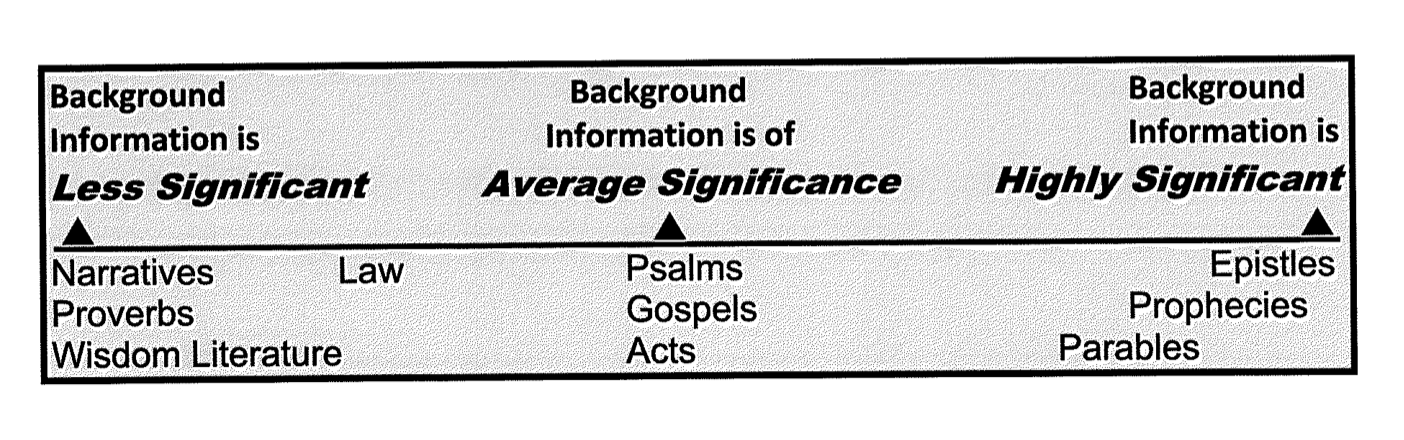
Significance of Background Information

One important thing to note, is that depending on the genre you are studying, that historical and cultural information will be more or less significant. Use the image below as a general rule of thumb.

Significance

Information taken from:

Hermeneutics/Coursepack by Russell