Hermeneutics

  • Getting Started
  • Resources
  • Tutorials
Menu
  • 1. Introduction
  • 2. Meaning Matters
  • 3. Genres
    • Narratives
    • Law
    • Psalms
    • Prophecy
    • Wisdom
    • Gospels
    • Parables
    • Acts
    • Epistles
    • Revelation
  • 4. Making Observations
  • 5. Application
  • 6. Putting it All Together
  • Bibliography

2. Meaning Matters

A text without a context is pretext. We tend to interpret verses or biblical stories primarily as free-standing units of thought rather than as parts of the broader whole of a specific biblical book.

From the top down

Meaning comes from the top down, not from the bottom up, from the larger units of Scripture to the smaller units. This is not just something we recognize when studying the Bible. You practice this daily and don't even realize it.

For example, when you turn reading the news on "The Onion" or "The New York Times", you are going to interpret and read the articles differently. This is because you understand the genre of communication. When reading "The Onion", you understand it is satire and you know "The New York Times" is not.

The key to understanding is to start with the largest unit of meaning and work your way down to the smallest unit. The largest unit of meaning is the genre and the smallest would be an individual word. Learn more about genres here. See the graphic below to get a clearer idea of how meaning flows from the top down.
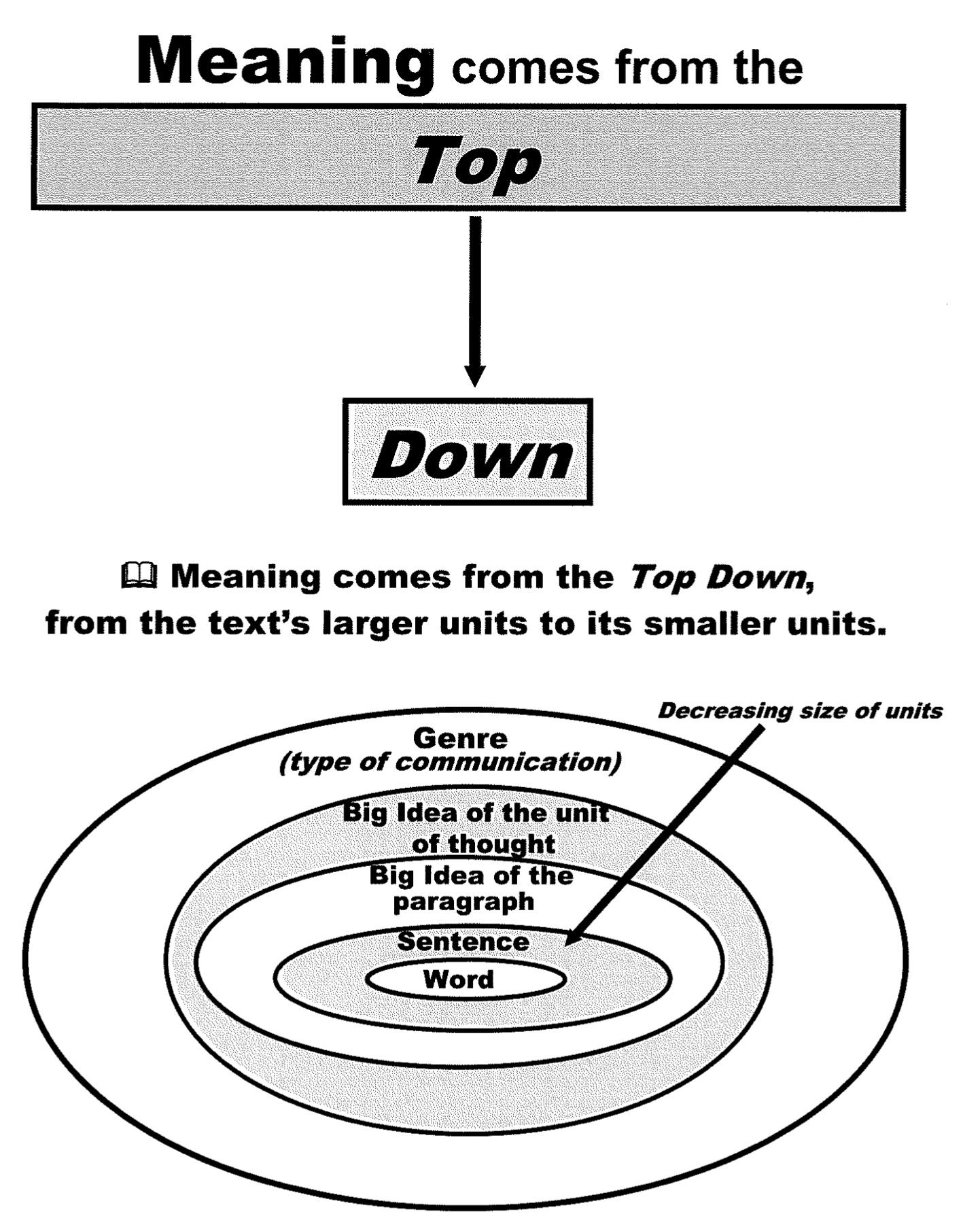
From the Top Down

Book Charting

One of the simplest ways to understand the greater textual meaning is to start making book charts of individual books of the Bible.

Charting Methodology
  1. Read for the BIG PICTURE of your passage.
  2. Determine the main contours of the skeleton or the structure of the biblical book.
  3. Decide how you want to chart the structure of the book, usually vertically or horizontally.

The goal of either style of chart is to show the interrelation of the parts to the whole of the book as the argument of the book unfolds.

  • Vertical charts tend to be more word-oriented and you can generally get more description on your chart.
  • Horizontal charts are visually powerful and it is readily obvious as to the flow of the argument.

To get a better idea of how to create a book chart, follow this tutorial on Jonah or Proverbs 5

Information taken from:

Hermeneutics/Coursepack by Russell